Thermodynamics & Chemistry
The Science Fusing Ashes in Glass
Suspending cremation remains inside glass is a precise physical and chemical reaction. At our Girdwood workshop, we utilize thermal-shock-resistant borosilicate glass and extreme furnace heat to fuse calcium phosphate minerals permanently.
1. Mineral Composition of Ashes
Cremated remains are not organic carbon (which is oxidized and vaporized during cremation at 1,400°F–1,800°F). Instead, the remaining ash consists of **calcium phosphate** ($Ca_3(PO_4)_2$) and trace sodium, potassium, and magnesium salts.
These minerals have an incredibly high melting temperature (around 3,000°F / 1,670°C), meaning they do not melt or vaporize at the glassblowing bench. They remain solid, suspended inside the glass matrix.
2. The Fusing Reaction at 2,100°F
During the gather phase, Darby collects molten glass at a temperature of **2,100°F (1,150°C)**. The ash is introduced to the core:
| Process Stage | Temperature | Chemical / Physical Action |
|---|---|---|
| Gathering | 2,100°F (1,150°C) | Molten borosilicate glass is pulled from the crucible. |
| Imprinting | 1,800°F (980°C) | Ash is picked up; trace organic carbon burns away instantly, leaving pure calcium phosphate. |
| Encapsulation | 1,950°F (1,065°C) | A second layer of glass is gathered, trapping the ash and pocketing micro air bubbles (forming 'constellations'). |
| Annealing | 1,050°F down to Room Temp | Slow controlled cooling in a digital kiln over 12–18 hours to release molecular stress. |
3. Bubble Constellations & Light
As the ashes are encased within the glass layers, microscopic pockets of air are captured. These bubbles, combined with the white calcium mineral particles, create high-contrast points of light that reflect and sparkle. When light hits the glass crystal, the refractive index of the glass bends the rays, making the ash swirls glow like cosmic nebulae.
4. Kiln Annealing for Structural Integrity
Because glass and ash expand and contract at slightly different rates, the piece would crack as it cools naturally. To prevent this, every Cremains Crystal is placed inside a computer-controlled **annealing kiln**. The temperature is held at 1,050°F to allow the molecules to align, and then slowly brought down over hours. This process guarantees lifetime structural integrity.
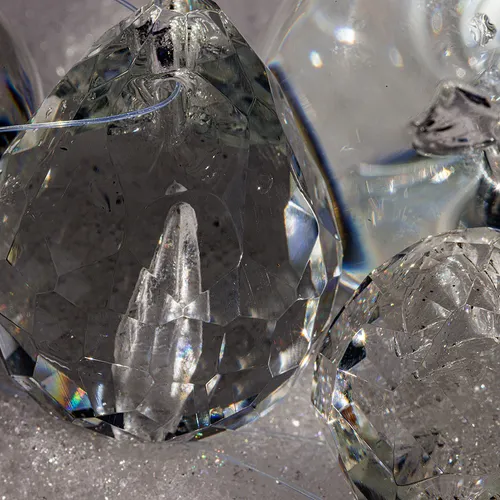
Molecular Entrapment
Faceted and rounded crystals displaying the swirled mineral layers and gas bubble 'constellations' suspended forever inside solid glass.